
Solution Architect Playbook

Updated: Aug 17
Stop Building Courses. Start Architecting Solutions.
Imagine telling an architect:
“We need a three-story building. Go build it.”
You’d expect them to ask a few questions first.
What does the building need to accomplish? Who will use it? What will they do there? What constraints exist? What’s the budget? What tradeoffs are acceptable?

Yet in Learning & Development, we routinely receive the equivalent request:
“We need an eLearning course.”
“We need a workshop.”
“We need an AI simulation.”
And too often, those requests become the starting point for design.
They shouldn’t be.
Before deciding what to build, we need to understand what performance we’re trying to create.
That’s the role of the Learning Solution Architect.
The Solution Architect starts by defining the desired state: If this initiative were successful beyond belief, what would people be doing differently, and what business results would we see? Then we examine what people are doing today and the gap between the two.
Only then should we start thinking about solutions.
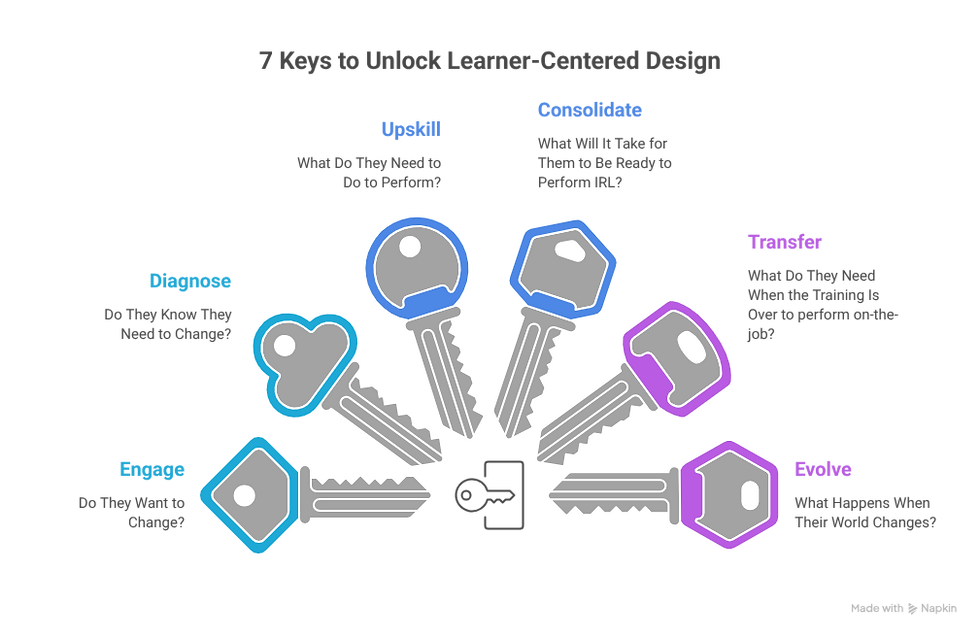
I developed the EDUCATE framework to help make that process more systematic. It reframes design around the audience’s journey from current to desired performance:
Engage — Why should I change?
Diagnose — What should I change?
Upskill — How do I change?
Consolidate — How do I make the new capability stick?
Assess — Have I achieved the desired capability?
Transfer — How do I sustain and apply it on the job?
Evolve — How do I adapt as my role and the business continue to change?
The important shift is that none of those questions starts with content or modality.
A workshop, eLearning module, AI roleplay, video, coach or job aid is simply one potential intervention. Each has different strengths, costs, scalability and limitations. The Solution Architect's job is to determine which combination best addresses the performance need while working within the realities of the organization.
And that leads to what may be the most important idea:
The answer is rarely a single course or other activity.
It’s more often an ecosystem of complementary experiences—each there for a reason and each contributing to the desired performance.
I explore this approach in much more detail in my new Solution Architect Playbook, E-D-U-C-A-T-E Your Way to Better Learning Outcomes.
Read the full ebook: E-D-U-C-A-T-E Your Way to Better Learning Outcomes


Comments