
Assess: How to Measure Competence, Not Just Knowledge

Updated: Aug 18
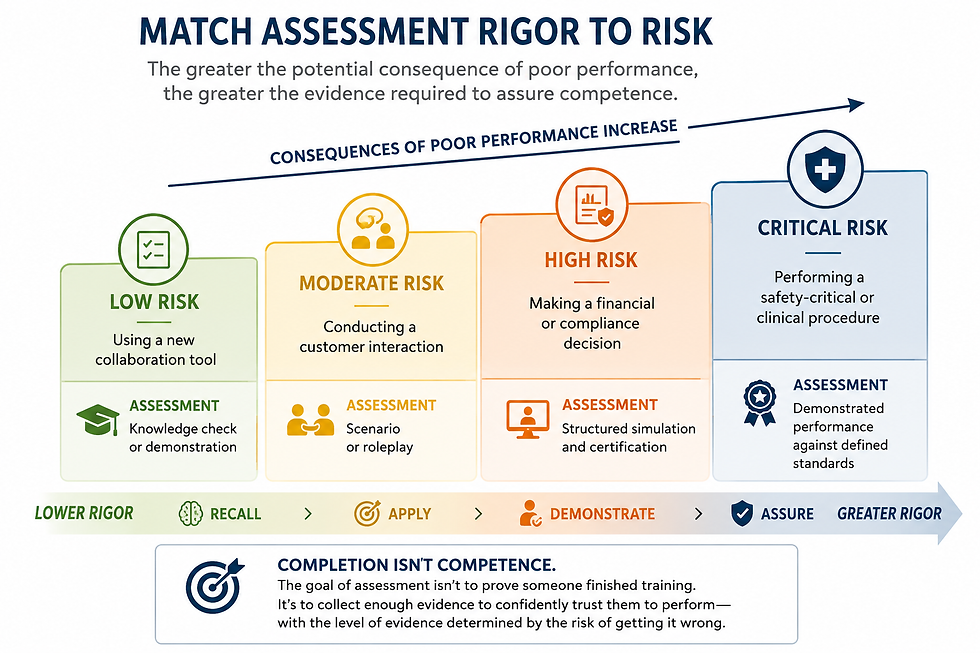
The purpose of Assess is to determine whether learners have developed the competence required to perform successfully in the workplace and, when the consequences of poor performance are significant, to provide assurance that they can do so safely and reliably.
Assessment is therefore not primarily about testing what learners remember. Recall is useful only when it is necessary for performance. The central question is whether the learner can apply the required knowledge and skills to achieve the desired outcome.
Assess answers the question: Can we confidently trust this person to perform the required behavior to the expected standard?
From Knowledge Testing to Competence Assurance
Traditional learning programs often equate assessment with a quiz or test. Learners complete a series of multiple-choice questions, achieve a passing score, and are considered "trained." But passing a knowledge test does not necessarily mean someone can perform.
A salesperson may know the steps of a discovery methodology but struggle to conduct an effective discovery conversation. A manager may correctly identify the principles of effective feedback but fail to apply them when an employee becomes defensive. A healthcare worker may recall a procedure but fail to execute it correctly under pressure. Assessment should mirror the performance we need to assure.
If the desired outcome is knowledge, a knowledge test may be appropriate. If the desired outcome is a behavior, assessment should observe the behavior. If the desired outcome is complex performance, assessment should recreate the conditions in which that performance will be required.
Risk Should Determine the Level of Assurance
Not every capability requires the same degree of assessment. The Solution Architect should consider the potential risk and consequences of poor performance when determining how much assurance is necessary.
For low-risk activities, demonstration of understanding may be sufficient. For higher-risk activities, the organization may need evidence that the employee can reliably perform under realistic conditions before allowing independent performance.
For example:
Risk Level | Example | Appropriate Assurance |
Low | Using a new collaboration tool | Knowledge check or demonstration |
Moderate | Conducting a customer interaction | Scenario or roleplay |
High | Making a financial or compliance decision | Structured simulation and certification |
Critical | Performing a safety-critical or clinical procedure | Demonstrated performance against defined standards |
The principle is simple. The greater the potential consequence of poor performance, the greater the evidence required to assure competence. This also prevents over-engineering assessment for low-risk learning. A simple knowledge check may be entirely appropriate when the consequences of failure are minimal.
Assess the Performance
A well-designed assessment defines:
What the learner must be able to do.
The conditions under which they must do it.
The standard they must meet.
Which errors are acceptable.
Which errors are unacceptable.
What evidence demonstrates competence.
This creates a clear connection between the desired state established during performance consulting and the evidence collected during assessment.
Assessment Approaches
The Solution Architect has a broad range of options for assuring competence.The following is a partial list.
Assessment Experience | Example Media | Best Used For |
Knowledge assessment | Quiz, test, adaptive assessment | Verifying essential knowledge |
Scenario assessment | eLearning, branching scenario | Decision making and judgment |
Simulation assessment | AI simulation, virtual simulation, live simulation | Complex integrated performance |
Roleplay assessment | Live evaluator, virtual session, AI evaluation | Communication and interpersonal skills |
Demonstration | Live observation, video submission, simulation | Procedural or technical skills |
Work sample | Real assignment, project, presentation | Authentic job performance |
Observation | Manager, assessor, peer, customer | On-the-job behaviors |
Portfolio | Digital portfolio, project evidence | Complex professional capabilities |
Certification | Exam, practical demonstration, assessment center | Formal assurance of proficiency |
Self-assessment | Survey, reflection, skills inventory | Awareness and development planning |
Manager assessment | Structured observation, performance review | Workplace readiness |
Customer assessment | Customer feedback, quality scores | Customer-facing performance |
Performance data | Quality, sales, productivity, safety metrics | Evidence of sustained performance |
Assessment as a Gate
In higher-risk environments, assessment can serve as a gate between learning and independent performance.
Learners develop the required capabilities, practice them in increasingly realistic situations, and then demonstrate sufficient competence before being cleared to perform independently.
This is particularly important when poor performance could result in:
Safety incidents
Regulatory violations
Financial loss
Customer harm
Security breaches
Legal exposure
Reputational damage
In these situations, "completion" is not enough. The organization needs evidence that the employee is ready.
Key Questions the Assess Phase Answers
What level of competence is required?
What evidence would demonstrate that competence?
How closely should the assessment replicate actual performance?
What are the consequences of poor performance?
How much assurance is necessary given the level of risk?
What errors are acceptable and which are unacceptable?
Does the learner need to demonstrate competence before performing independently?
How will competence be maintained and reassessed as conditions change?
The purpose of Assess is not to prove that someone completed training. It is to provide the level of evidence and assurance appropriate to the consequences of their performance.


Comments