
7 Keys to Learner-Centered Design

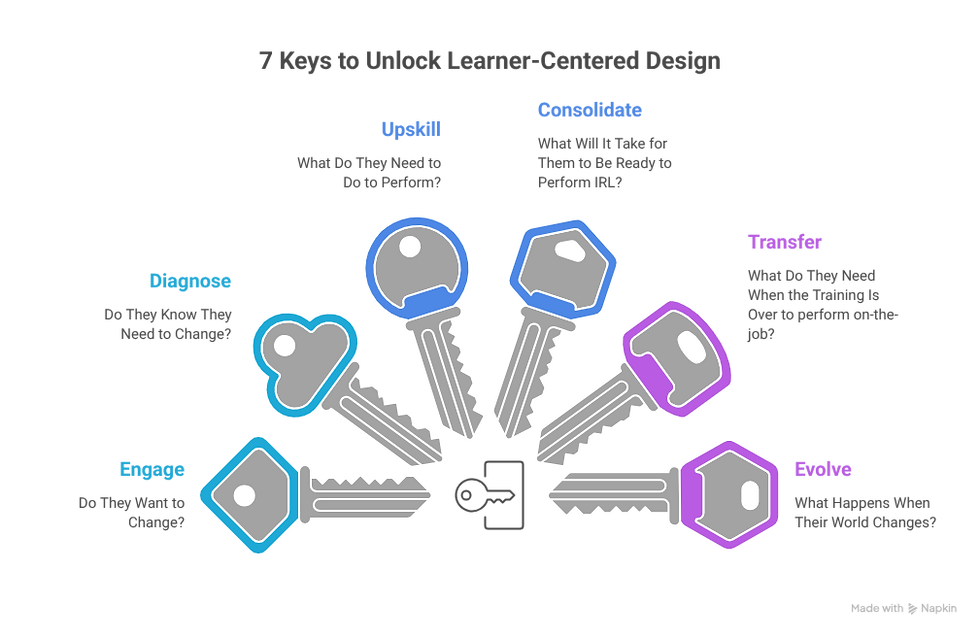
Learner-centered design sounds like one of those ideas no one could possibly disagree with.
Of course learning should be centered on the learner. Dig a little deeper, though, and the concept becomes surprisingly slippery. One academic definition describes Learner-Centered Design as an approach to educational software and learning environments that shifts the emphasis from task efficiency to task comprehension.
Huh?
Not the most useful thing when you're sitting in a meeting trying to decide what to do about 2,000 salespeople who aren't conducting effective discovery conversations.
Yet that hasn't stopped generations of learning designers, including me, from saying:
“We believe in learner-centered design.”, but what exactly are we designing around?
Often, learner-centered comes to mean things like making content engaging, offering choices, personalizing a learning path, using relatable examples, reducing cognitive load, or giving learners control over pace. All good things. But I think there's a much bigger opportunity.
What if learner-centered design meant starting with a holistic understanding of what people actually need in order to successfully change their performance? That's the idea behind the EDUCATE framework.
From Learner-Centered Content to Learner-Centered Performance
Most learning design processes eventually become content-centered.
What do people need to know?
What are the learning objectives?
How should we organize the content?
Should this be a workshop, eLearning course, video, simulation, or AI experience?
Those are legitimate design questions. But they come too early. Suppose a company wants managers to have more effective performance conversations. The immediate reaction might be to teach a feedback methodology.
But …
What if managers already know the methodology?
What if they don't believe having these conversations will improve performance?
What if they think they're already excellent at giving feedback?
What if they understand the approach but haven't practiced enough to use it confidently when an employee becomes defensive?
What if they're perfectly capable but their leaders implicitly discourage candid conversations?
What if they improve today, but the organization's performance-management process changes six months from now?
Those are all learner needs and potential barrier to improving performance. .
EDUCATE treats learner-centered design as a much broader interrogation of what an audience needs to move successfully from current performance to desired performance.
It asks seven questions.
Engage: Do They Want to Change?
We frequently assume that because the organization wants employees to behave differently, employees will naturally want to behave differently too.
That's a dangerous assumption.
Before teaching anything, ask:
Is the target audience's motivation aligned with the desired change?
Do they understand why changing their behavior matters?
Do they believe the new behavior will produce better outcomes for them, their customers, their team, or the organization?
If not, what needs to happen to align motivation with the desired change?
How will we build commitment rather than simply communicate expectations?
Sometimes the first learning need isn't “show me how.”
It's “convince me why.”
A learner-centered solution recognizes that distinction.
Diagnose: Do They Know They Need to Change?
There's another assumption hidden in many learning programs:
We know employees need to improve, therefore employees know they need to improve. Not necessarily.
Someone can be quite confident in a behavior that isn't producing the desired result.
So Diagnose asks:
Is the audience aware of its need to improve or change?
How accurately do employees understand their current capabilities?
What evidence could help them recognize the gap?
How might development be personalized based on individual strengths and needs?
This might require self-assessment, feedback, observation, performance data, benchmarking, simulations, or other ways of making the gap visible. That creates a fundamentally different starting point.
Instead of telling someone:
“Here's what we're going to teach you.”
We're helping them discover:
“Here's where I need to get better.”
Upskill: What Do They Actually Need to Become Capable of Doing?
Now we get to territory that looks more familiar to L&D. But even here, learner-centered design requires greater precision.
Skills
What new capabilities or behaviors does the audience need to develop or improve to perform confidently?
If someone needs to conduct better discovery conversations, for example, they may need to become better at probing vague answers, recognizing signals worth exploring, challenging assumptions, or connecting customer needs to potential solutions.
Those are things people need to do, which means they need experiences that help them develop those skills—not merely information explaining them.
Enabling Knowledge
Knowledge still matters. But the question shouldn't be:
What do we want to teach?
It should be:
What does the learner need to know or be able to access to execute the required capabilities successfully?
Product information might enable a salesperson to recommend the right solution. A framework might enable a manager to structure a difficult conversation. A policy might enable an employee to make an appropriate decision.
Knowledge has a job to do, but if it doesn't enable performance, we should question why we're asking the learner to spend time on it.
Consolidate: Can They Put It All Together?
Knowing something isn't the same as being able to do it. And performing a skill successfully once isn't the same as being able to perform it reliably in the field. Real performance requires people to integrate capabilities while dealing with complexity, ambiguity, pressure, and variation.
So we ask:
What opportunities do learners need to integrate their skills and rehearse new capabilities until the desired behaviors become increasingly confident and dependable?
That might mean roleplays, simulations, case work, increasingly difficult scenarios, coached practice, real-world assignments, or repeated application with feedback.
Assess: Are They Ready?
Traditional learning assessment often asks whether someone learned what we taught. Learner-centered assessment asks a different question: Is this person ready to perform successfully?
And sometimes we don't need to formally answer that question. The level of assessment should reflect the consequences of poor performance. For a low-risk behavior, practice and feedback may be sufficient. For something consequential, e.g., operating equipment, providing regulated advice, handling sensitive customer situations, the organization may need much stronger evidence of competence.
Assessment isn't something we bolt onto the end because every course needs a quiz. It's another learner need to be deliberately considered.
Transfer: What Will They Need When the Training Is Over?
The learning experience eventually ends. The learner's job doesn't. So what happens Tuesday afternoon when they need to perform?
Do they need a checklist? A template? A searchable knowledge resource? An AI assistant? Manager coaching? A workflow prompt? Feedback? Access to information that would be ridiculous to memorize?
Or perhaps the problem isn't with the learner at all. Maybe a broken process, conflicting incentive, difficult system, lack of time, or unsupportive manager prevents capable people from doing what they've learned. If our mission is to improve performance, on-the-job suppor and the work environment are part of our design brief.
Evolve: What Happens When Their World Changes?
This may be the most overlooked element of learner-centered design. We tend to design toward a desired state as though it were permanent. It isn't.
Business strategy changes. Technology changes. Products change. Regulations change. Customer expectations change. AI changes how work gets done. And employees themselves develop new capabilities.
Today's desired performance eventually becomes tomorrow's current state. That's why Evolve treats significant change as a trigger to restart the process.
Redefine the desired state.
Reassess current performance.
Reexamine learner needs.
Adapt the solution.
Learner-centered design isn't something you do once for the learner. It's an ongoing process of staying aligned with what the learner needs as their work evolves.
Maybe We Need a More Demanding Definition
None of this means the familiar principles associated with learner-centered design are wrong.
We should make experiences relevant. We should respect learners' time. We should give them agency where appropriate. We should design usable, accessible, engaging experiences.
But those principles don't go far enough. A beautifully designed learning experience can still be remarkably learner-unfriendly if it teaches employees something they don't need, fails to give them practice they do need, ignores their motivation, assumes everyone has the same starting point, or sends them back to an environment that makes the desired behavior nearly impossible.
That's why I think learner-centered design needs a more demanding standard.
Don't just center the learning experience on the learner. Center the entire solution on what the learner needs to perform successfully.
That's what EDUCATE is intended to make practical.


Comments